
Discovery Under the Microscope
Many of my photographs begin with a plan. I select a specimen, think about magnification, consider lighting, and then set out to create a particular image.
This photograph began differently.
My grandchildren were visiting, and I was showing them how a stereo microscope makes small objects appear much larger. Like many children, they were fascinated by seeing familiar things transformed into strange new worlds simply by increasing the magnification.
One of the specimens I placed under the microscope was an Eupholus weevil. The goal was not photography. It was simply exploration.
As we examined different parts of the insect, one structure immediately caught my attention: the tarsus, the distal portion of the leg ending in a pair of claws. Under magnification it no longer looked like an anatomical structure. Instead, it appeared sculptural. The curved form, repeating segments, and hooked claws created a shape that felt more like a piece of modern art than an insect appendage.
The more I studied it, the less interested I became in what it was and the more interested I became in how it looked.
After my grandchildren left, I returned to the studio and decided to photograph it.
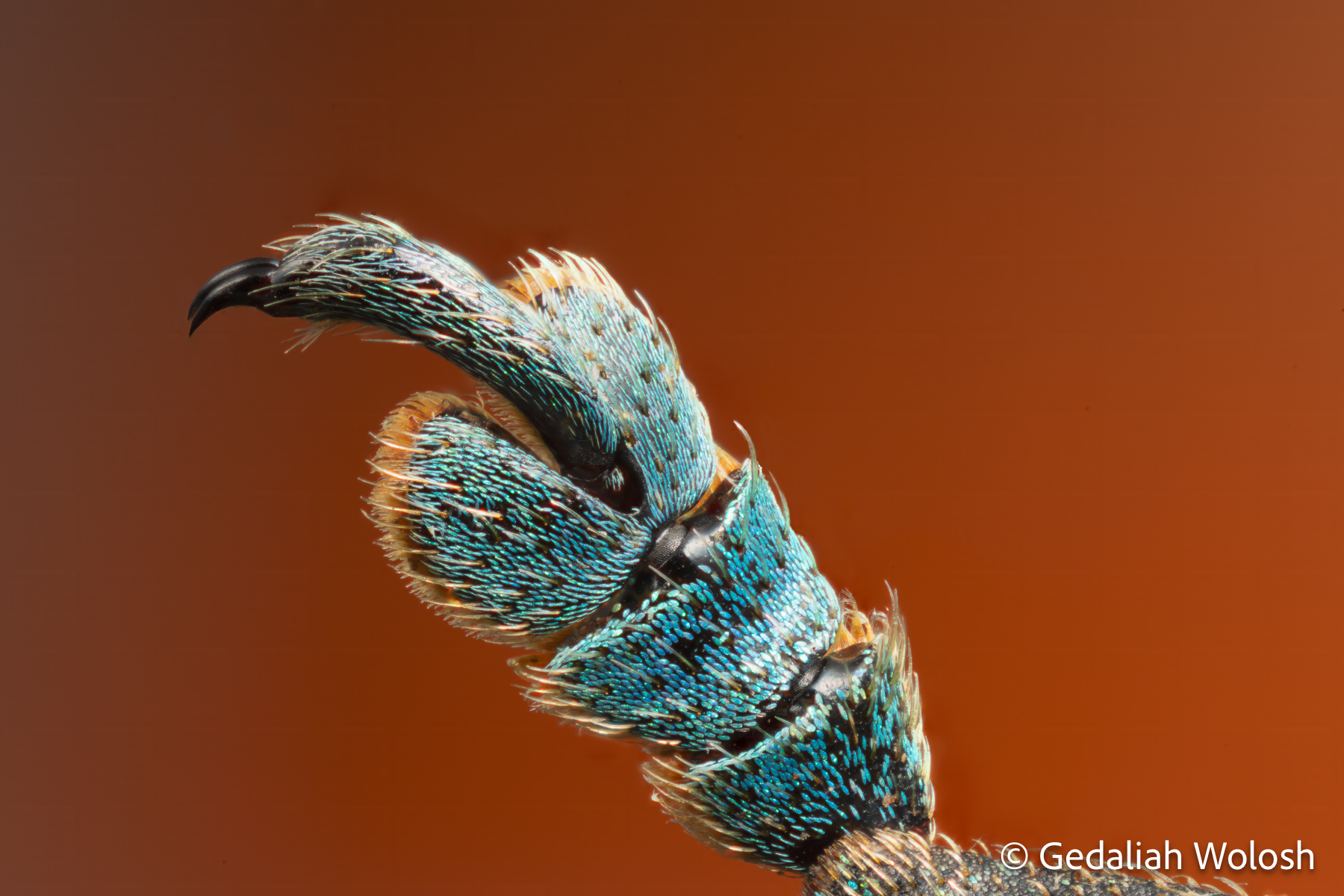
An abstract macro photograph of a Eupholus weevil tarsus, emphasizing curve, texture, and contact.
The specimen required almost no preparation. The detached tarsus was mounted directly to a pin without rehydration or posing. Fortunately, it already possessed a graceful natural curve. Rather than forcing the specimen into a more conventional orientation, I chose to preserve the shape exactly as I found it.
The image was created at approximately four to five times life size using a reversed enlarging lens mounted on a bellows system. A stack of sixty-three images was captured and combined using focus stacking techniques to render the entire structure sharply while preserving a soft, unobtrusive background.
What attracted me most was the tension between abstraction and reality.
Viewed without context, many observers would not immediately recognize the subject. The repeating segments suggest articulated armor. The claws resemble hooks or talons. The iridescent blue-green scales create patterns that appear almost woven rather than biological. Only after closer examination does the viewer realize he is looking at part of an insect leg.
This transformation is one of the things I enjoy most about macro photography. Magnification allows familiar objects to escape their ordinary identities. A soap film becomes a landscape. An insect eye becomes a mosaic. A weevil’s foot becomes a sculpture.
The photograph also serves as a reminder that discovery often happens when we are not looking for it. I did not set out to create this image. I was simply sharing a microscope with my grandchildren. The photograph emerged from curiosity, observation, and the willingness to pause when something unexpected appeared in the field of view.