
Butterfly Wings: A return to the studio
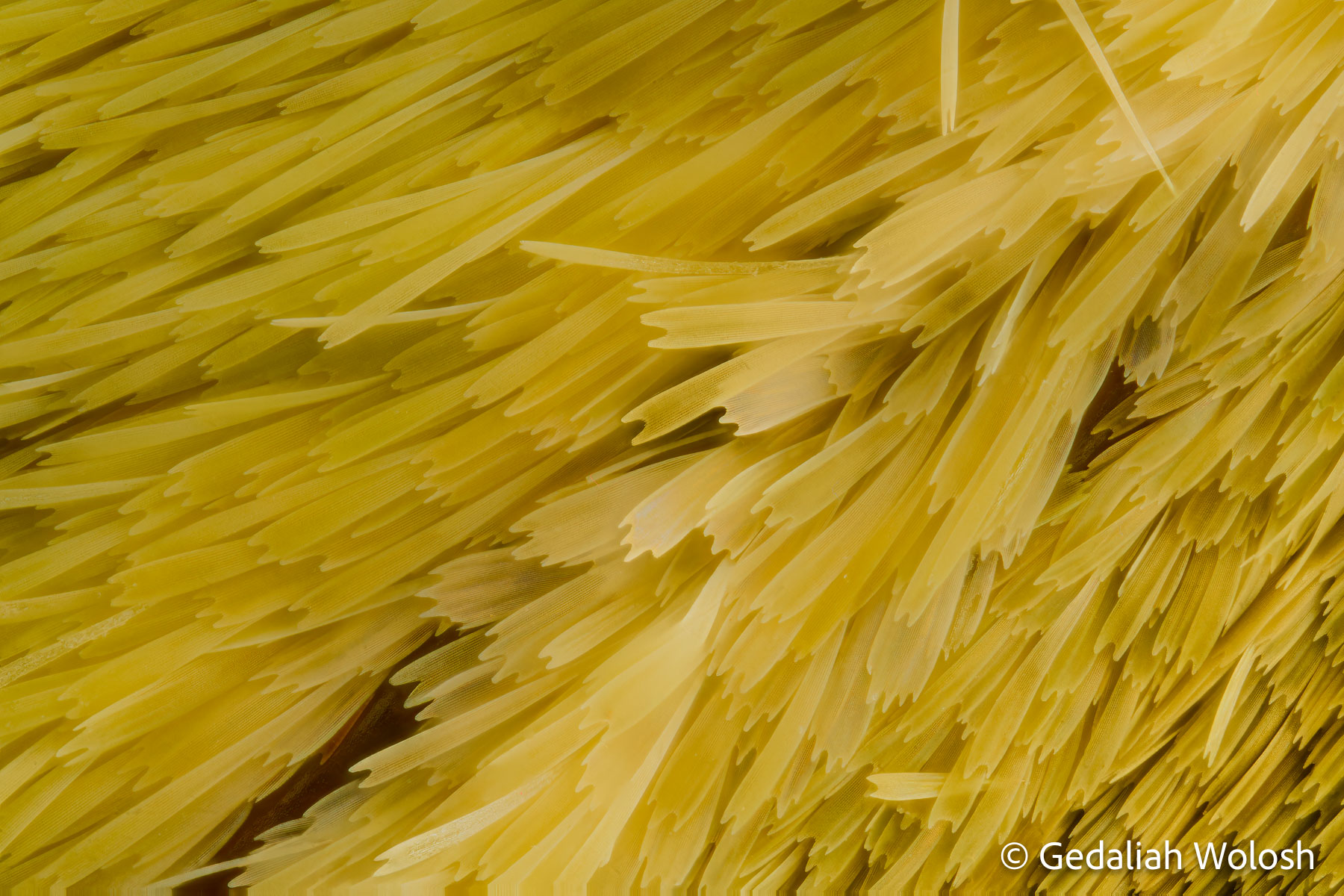
After several months away from the studio, I returned with a renewed focus—this time on the intricate beauty of butterfly and moth wings at high magnification. This image marks the beginning of a new series, using the Venus Laowa Aurogon FF 10–50× NA0.5 Supermicro APO lens system to explore the dense arrangement and pigmentation of golden scales on a moth wing. The tight layering and forked tips of the scales produce a bristling, sculptural texture, offering both technical challenge and visual reward.
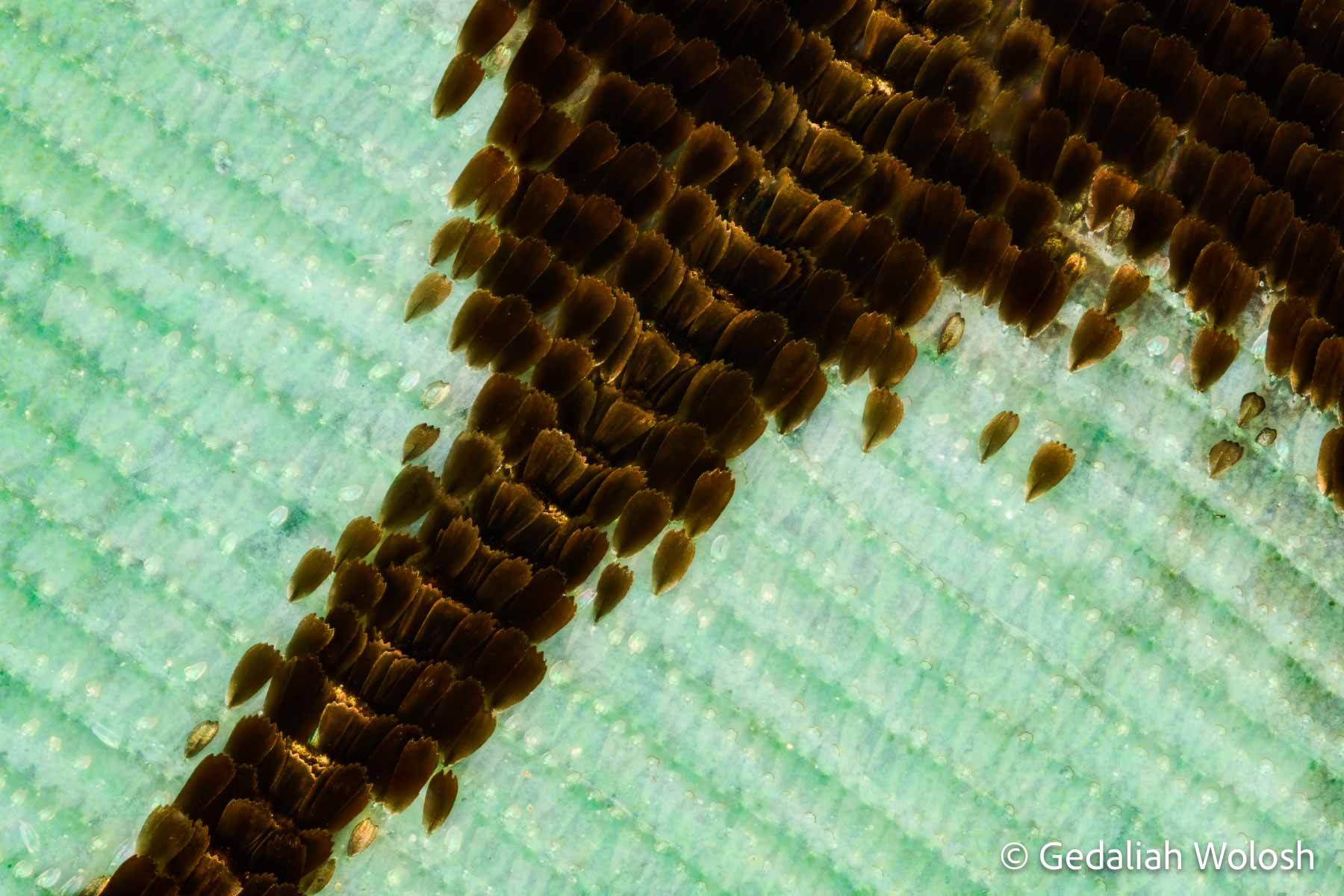
This striking view comes from the wing of Philaethria dido, a butterfly known for its translucent green windows. At 20× magnification, the scales are seen as overlapping ovals, forming a narrow diagonal band. Against the pale green wing membrane, their distribution appears both ordered and organic—dense at the center and tapering at the edges. Lighting from multiple angles brings out the three-dimensional structure, while subtle variations in pigmentation create tonal depth across the frame.
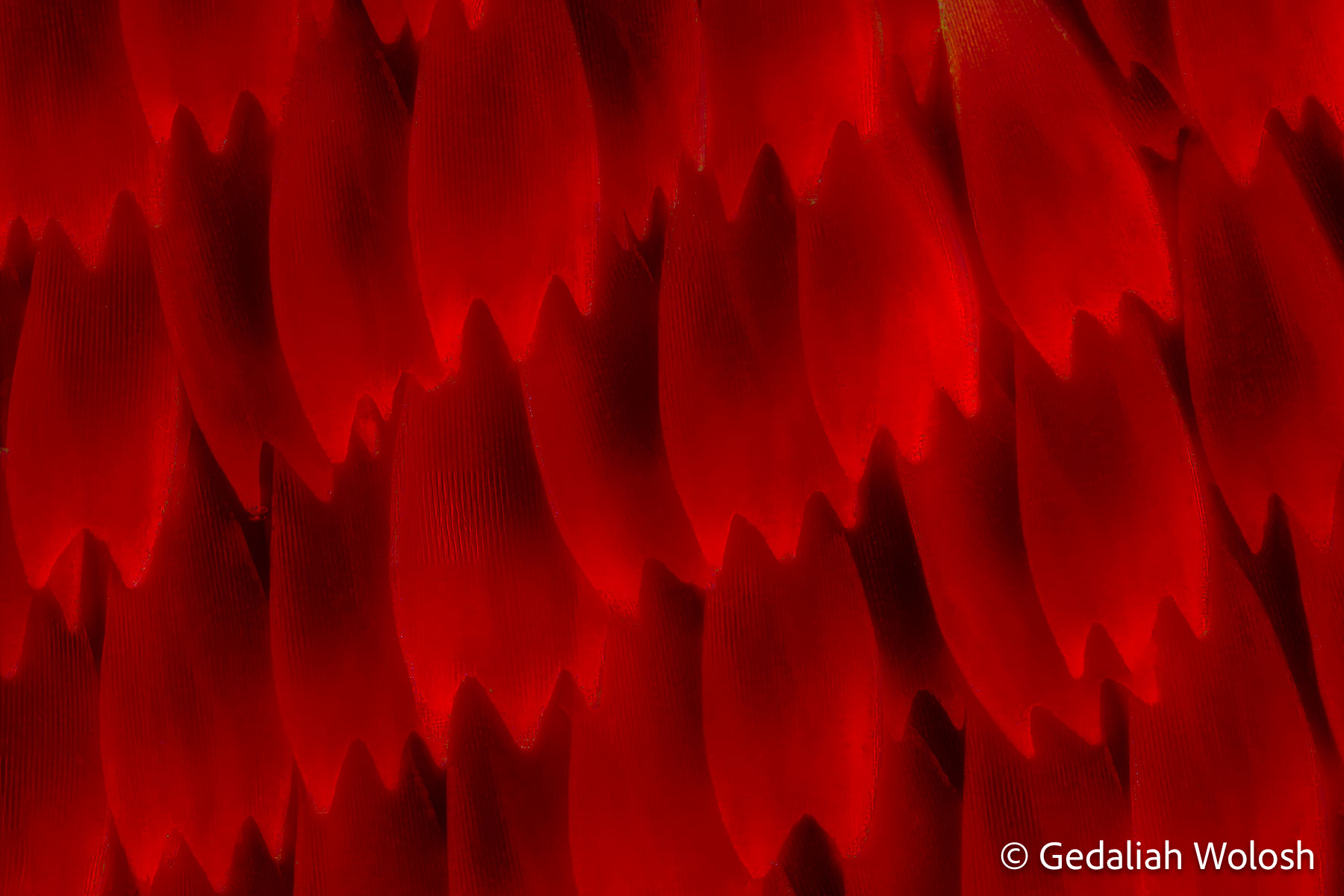
In this close-up, deep red scales dominate the frame with saturated color and a sense of rhythm. Captured at 50X magnification, this image reveals fine ridges and surface texture that are invisible at lower powers. Working at this scale presents challenges: limited depth of field, sensitivity to vibration, and lighting constraints all become more pronounced. Even slight misalignments in the stacking process can introduce artifacts. Despite these obstacles, the result is a tightly resolved field of pigment-rich scales—less about structure and more about saturation and visual density.
This image reveals a repeating pattern of alternating light and dark scales, interspersed with transitional tones that bridge the contrast. Rather than presenting a uniform field, the scales exhibit a visual rhythm—light and shadow playing across their surfaces to create a sense of movement and depth. The interplay of tones suggests layering and complexity, as some scales reflect more light than others depending on orientation. At 20× magnification, the image captures not only the alternating pattern but also the subtle imperfections that lend a natural, almost textile-like richness to the composition.
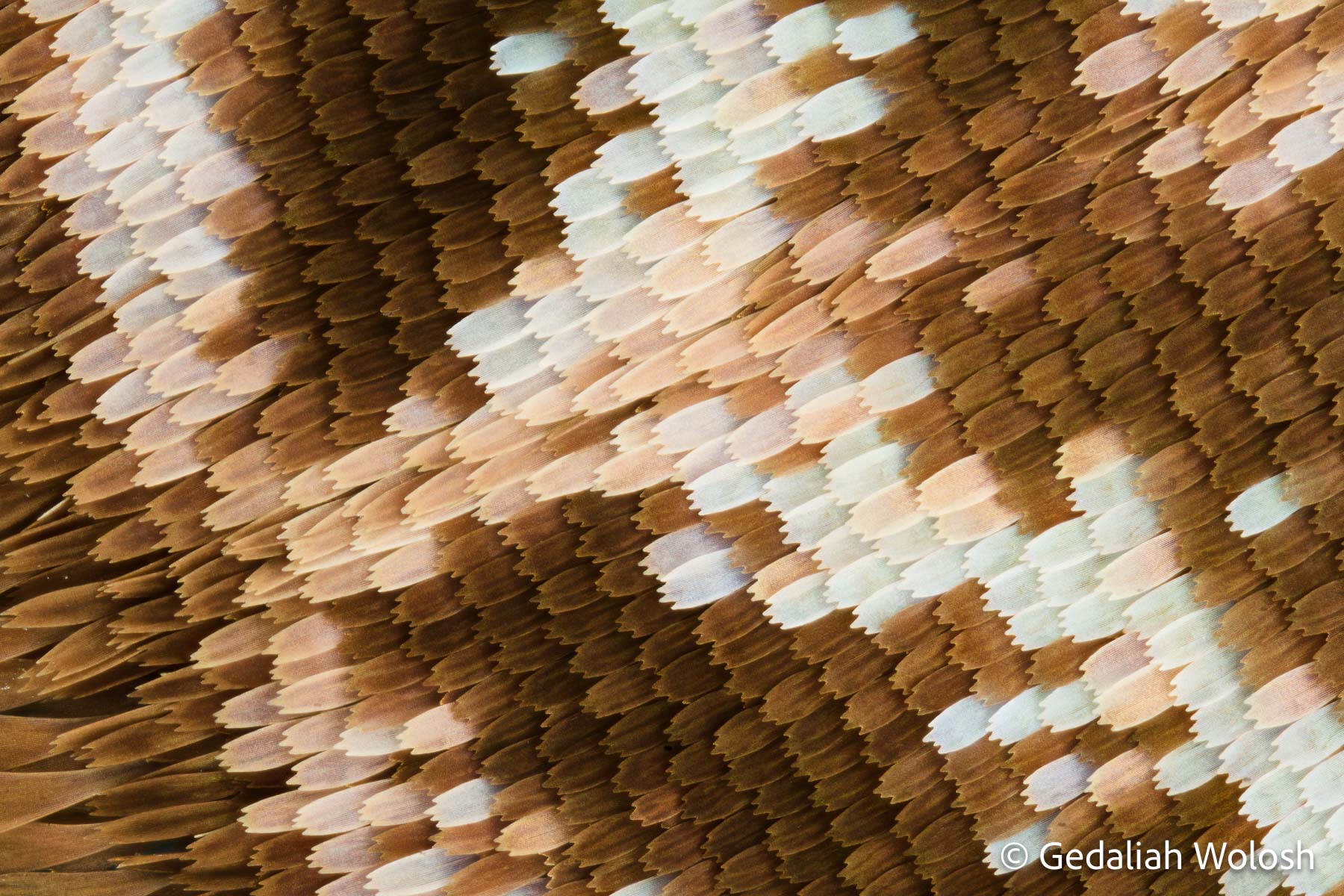
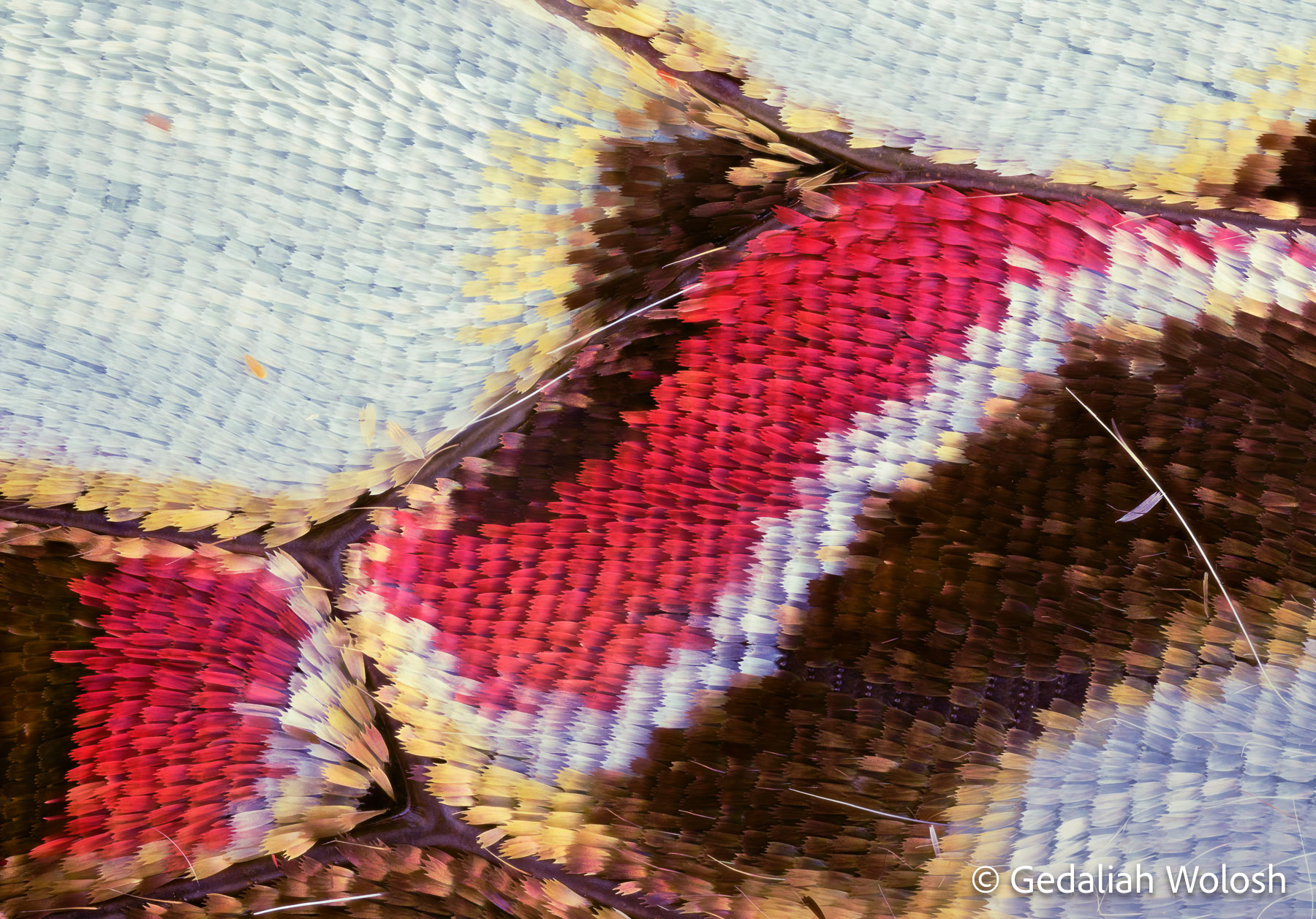
The final image in this blog post presents a complex quiltwork of red, white, and deep brown scales—a richly layered surface that draws the eye across interwoven regions of pigmentation and form.
Rather than forming uniform bands, the patterns interlock and diverge in an arrangement reminiscent of fabric piecing—structured, but not rigid. Capturing this image required a stack-and-stitch workflow: nine separate focus-stacked images were acquired, each consisting of approximately 100 exposures taken at slightly different focal planes. These were then combined into a panoramic mosaic to preserve both resolution and compositional scale. This approach allows for broader coverage than a single frame at high magnification, while retaining the microstructural clarity of each individual scale. The result is an image that invites both detailed inspection and broad visual engagement.
The goal here is not taxonomic classification, but visual exploration. Each wing fragment offers a distinct topography—an interplay of form, texture, and color shaped by evolution but open to interpretation. Some regions are built from pigmented scales that absorb and reflect specific wavelengths; others shimmer with structural color, the result of nanoscale ridges that diffract light into vivid hues. These are functional surfaces, evolved for camouflage, signaling, or thermoregulation—but they are also inherently expressive. Removed from their ecological context and seen through the lens, they become compositions of rhythm and contrast, structure and variation. In this way, the images serve as more than magnified specimens—they are studies in visual form, inviting the same kind of contemplation afforded to art, design, or architecture.
To see more butterfly and moth wings, visit the gallery.